
Between Chaos and Ceremony Baku Fashion Week
Presents Fall/Winter 2026–2027
There is something quietly audacious about a fashion week that opens with a brand called De Majnuns — Arabic for "the mad ones" — and closes with a collection called Back to Black. Baku Fashion Week's Fall/Winter 2026–2027 season moved between these two poles with confidence, assembling eight designers from Azerbaijan, Georgia, Latvia, Kazakhstan, and beyond into a programme that felt less like a regional showcase and more like a genuine conversation about what clothes are for, and who they're for, right now.
The season's emotional range was wide. Some collections turned inward, drawing on memory, identity, and transformation. Others pushed outward into structure, geometry, and the kind of controlled formalism that fashion uses when it wants to say something serious.
What connected them was an insistence on intention — on clothing that means something beyond its silhouette.
Controlled Madness — De Majnuns (Azerbaijan)
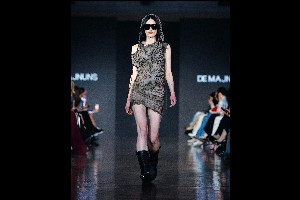
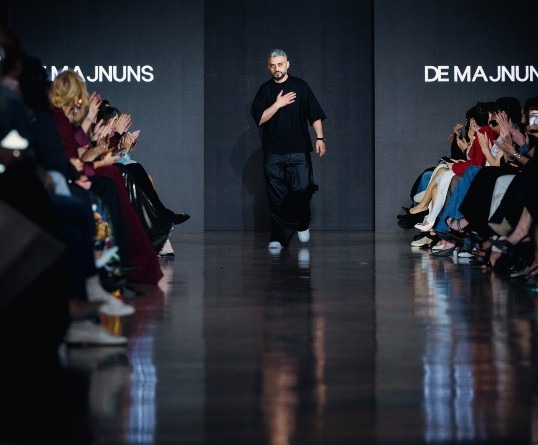
De Majnuns arrived at their debut runway show with a title that could have easily promised spectacle and delivered noise. Instead, Controlled Madness was precise, considered, and unexpectedly warm. Working primarily in treated denim and premium fabrics, the Azerbaijani brand built a menswear-led collection — with a unisex sensibility threaded throughout — around an earthy urban palette of blue, brick, and brown.
The tension the name promises is real, but it operates quietly: in texture, in structure, in the gap between the roughness of denim and the refinement of the cuts. Comfort and luxury are not opposites here but collaborators. For a debut, it announced a clear point of view — one grounded in precision and attitude rather than provocation.
Burning in Luxury — The House of Jesus Star (Georgia)
The House of Jesus Star's debut collection carried one of the season's most quietly striking titles: Burning in Luxury. The Georgian brand chose a register of absolute restraint — clean silhouettes, a strict black-and-white palette, and details designed to reveal themselves slowly, like something caught in candlelight.
The concept of quiet luxury has become almost a cliché in recent seasons, but the House of Jesus Star approaches it differently. This is not luxury that signals itself; it is luxury that simply exists, confident enough not to explain. A subtle shimmer of stars runs through the collection, adding depth without disrupting the calm. Elegance here is not a choice, the brand insists, but a state of being — and the clothes, at least, make that case convincingly.
Back to Roots — Uventa (Azerbaijan)
Khayala Asadova, the founder and designer behind Uventa, used the Fall/Winter season to look backward — but not in the way nostalgia usually works. Back to Roots is built from her own archives, her earliest collections revisited and reread from where she stands today. The result is not repetition but reconstruction: the past as raw material, not destination.
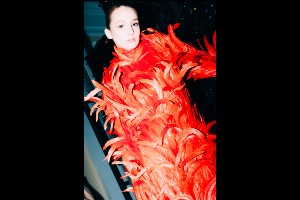
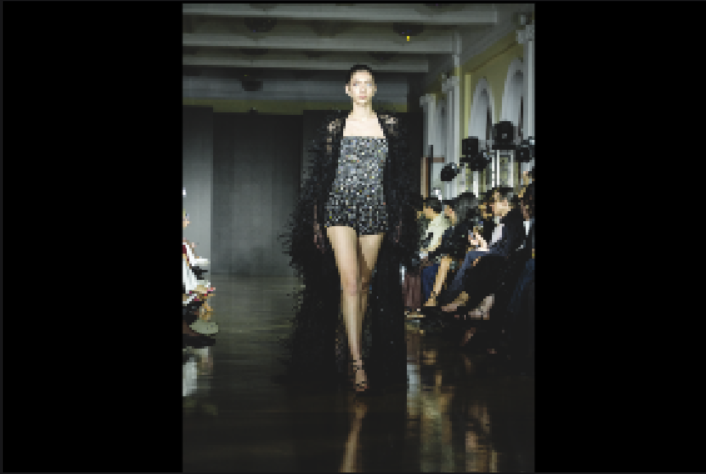
The collection translates this emotional logic into vivid colour and layered texture. Floral motifs and organic lines run through it alongside feathers and experimental surfaces, giving each look a tactile, almost living quality. Certain silhouettes carry a theatrical charge — they feel built for a stage, for a narrative, not just a runway. And yet Uventa's essential balance — femininity and inner strength held in careful proportion — remains intact throughout. A woman whose softness does not diminish her resilience, and whose expressiveness is itself a form of confidence. It is a collection about returning not as retreat, but as maturity.
Horizon — Leinea (Azerbaijan)
Also making its runway debut this season, Leinea arrived with a collection that felt like the visual equivalent of a held breath. Where some designers use a first show to declare ambition through volume or drama, Leinea made the opposite choice: restraint as proposition, precision as personality.
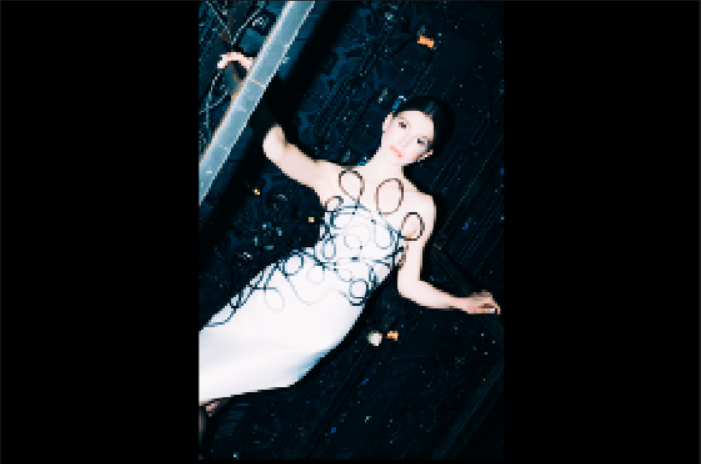
The collection is built around elongated silhouettes, open backs and long dresses that follow the body's natural line without imposing on it. Chiffon and silk do most of the work, fabrics chosen for their capacity to move without losing their shape — falling with a fluidity that reads as effortless while maintaining structural clarity. The balance between softness and control is the collection's central preoccupation, and it holds throughout.
The open back recurs as the defining gesture of the collection — not as provocation, but as an exercise in proportion. Seen from behind, these garments make their most compelling argument: line, balance, the body as architecture. The inspiration, reportedly, was coastal — the stillness of a horizon where sea meets sky, the quality of light just before dark. That atmosphere comes through, not in any literal way, but in the mood the clothes carry. Calm, assured, and quietly confident in their own simplicity.
For a debut collection, Leinea demonstrates something that takes many brands years to learn: that apparent simplicity is one of the harder things to achieve, and that clothes which seem to do very little are often doing the most.
Yamamaa (Azerbaijan)
Yamamaa's debut collection asked a deceptively simple question: what if a garment were not a static object, but a living structure? The Fall/Winter 2026 offering builds its concept around transformation — silhouettes that develop through movement, pieces that can be worn multiple ways, constructions that shift and evolve with the body over time.
In this framework, sustainability becomes not a marketing position but a natural consequence. Garments designed for longevity, adaptability, and multiple readings do not belong to a single season. They belong to the wearer's life, changing as she does. For a debut, Yamamaa's proposition is ambitious — and, if the construction holds to its promise, genuinely useful.
Ballad of the Enchanted Forest — Selina Keer (Latvia)
Selina Keer arrived from Latvia with one of the season's most overtly poetic collections, and committed to it fully. Ballad of the Enchanted Forest conjures a specific atmosphere — morning mist, the scent of wild blossoms, the stillness of a hidden lake — and builds its garments as expressions of that world.
Fabrics move softly, feathers appear weightless, silhouettes suggest flight or a flower opening. The woman at the centre of this collection is in dialogue with nature, not dominating it — she is its most beautiful melody, as the brand puts it. The romanticism is deliberate and worn without apology. In a season that leaned heavily toward structure and control, Selina Keer's willingness to be openly dreamlike felt like its own kind of confidence.
Rebirth of the Soul — Zumrud Mirzaliyeva (Azerbaijan)
Zumrud Mirzaliyeva did not present a new collection so much as a manifesto. Rebirth of the Soul is built around a central image — rising from ashes — and traces it across 25 looks with an intensity that doesn't let up. Silhouettes balance rigidity and fluidity, destruction and creation, mapping the emotional logic of transformation onto the body.
The collection's guiding phrase — "remain strong without losing your elegance" — is the kind of statement that could read as empty if the clothes didn't earn it. Here, they do.
Feminine strength is not expressed through hardness but through the capacity to rebuild: to gather the fragments, rise from the fall, and return more whole than before. It is a story told in form and fabric, and it lands.
Art Is Not Enough — Zhsaken (Kazakhstan)
Zhsaken came with the season's most intellectually layered proposition. Art Is Not Enough draws its inspiration from the world of contemporary art biennales — environments where gesture, text, and symbol coexist in continuous, unresolved dialogue — and uses that tension as a design principle.
The silhouettes reflect this directly: sharp structured forms alongside softer fluid volumes, control in dialogue with movement. A palette of soft blush pink, silver, and sky blue is punctuated by vivid red, yellow, and deep blue, creating rhythm and visual intensity across the collection. Details retain an expressive, almost raw quality, and a deliberate sense of incompleteness runs throughout — each look feels open to continuation, as though the collection itself refuses to be finished. It is fashion as ongoing process, and it makes for compelling viewing.
Back to Black — Sultan Gadimbayli (Azerbaijan)
Sultan Gadimbayli closed the season, and did so on his own terms. Back to Black is not a return to a colour; it is a return to essence — a stripping away of excess to reveal what remains when everything unnecessary is removed.
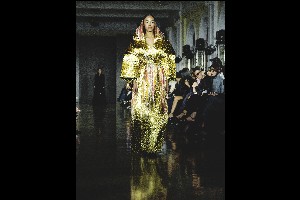
Drawing on the minimalism of the 1990s and the discipline of couture, Gadimbayli built a collection around control, structure, and stance. Jersey and fluid satin follow the body; crepe and structured constructions sharpen the silhouette; embellished surfaces catch the light; fur textures introduce raw luxury. Strong shoulders, defined waists, asymmetry, elongated lines — the vocabulary is architectural and deliberate. Black here is not simply a colour. It is a manifesto.
Presented as the closing show of the season, Back to Black served as a reminder that true power reveals itself in its simplest form. As a final statement, it was apt: precise, unfussy, and impossible to ignore.